The Constitutional Court of Thailand: Development, Jurisdiction, and Political Significance Since 1997
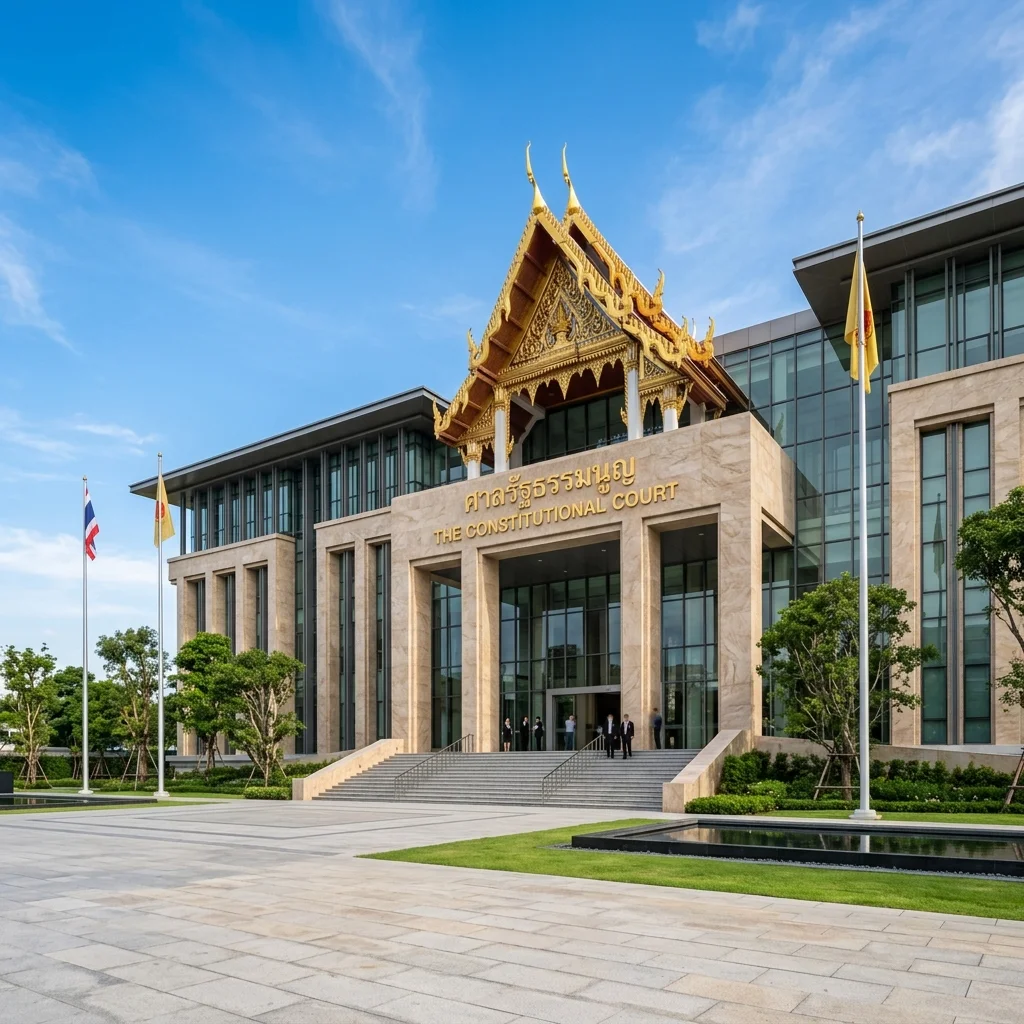
The Constitutional Court of Thailand has evolved from a specialized constitutional review body into one of the most influential institutions within the Thai political system. Established under the 1997 Constitution, the Court was initially intended to safeguard constitutional supremacy and resolve disputes concerning constitutional interpretation. However, following the military coups of 2006 and 2014, the Court assumed a more prominent role in political affairs. This article examines the historical development, constitutional jurisdiction, landmark rulings, and ongoing debates surrounding the Court's role in Thailand's constitutional order.
Introduction
The Constitutional Court of Thailand (ศาลรัฐธรรมนูญ) was established under the Constitution of the Kingdom of Thailand B.E. 2540 (1997), often referred to as the "People's Constitution." Inspired by European constitutional court models, particularly those of Austria and Germany, the institution was designed to serve as the ultimate interpreter and guardian of the constitution (Constitutional Court of Thailand, n.d.). Over time, the Court's influence expanded considerably, leading to extensive academic and political debate regarding judicial power, democratic legitimacy, and the separation of powers.
Historical Development
Prior to 1997, Thailand lacked a specialized constitutional court with independent authority to review legislation and resolve constitutional disputes. Constitutional matters were generally addressed through political mechanisms or the ordinary judiciary.
The 1997 Constitution introduced the Constitutional Court as part of broader political reforms aimed at strengthening democratic institutions and promoting government accountability. The Court was modeled on the Kelsenian system of constitutional review, which separates constitutional adjudication from the ordinary judiciary (European Law Institute, n.d.).
Subsequent constitutions, particularly those enacted after the military coups of 2006 and 2014, expanded the Court's authority and reinforced its role as a key constitutional actor within Thailand's political framework.
Constitutional Jurisdiction and Powers
The Constitutional Court possesses extensive constitutional review powers, including:
- Reviewing the constitutionality of legislation;
- Resolving disputes between state institutions;
- Adjudicating cases involving political parties;
- Determining the qualifications and eligibility of public officials;
- Interpreting constitutional provisions;
- Reviewing constitutional amendments for compatibility with fundamental constitutional principles.
The Court's rulings are binding upon all state agencies and have immediate legal effect. Consequently, its decisions often carry significant political implications beyond purely legal considerations (Constitutional Court of Thailand, n.d.).
Judicialization of Politics After 2006
The military coup of September 2006 marked a turning point in the Court's political significance. Under the 2007 Constitution, the Court acquired broader powers and became increasingly involved in resolving major political disputes.
Political scientist Duncan McCargo (2014) describes this development as the "judicialization of Thai politics," a process through which political conflicts are increasingly resolved through judicial rather than electoral or legislative mechanisms. According to this perspective, courts have become central actors in political governance, particularly during periods of institutional crisis.
Supporters argue that judicial intervention is necessary to preserve constitutional order and prevent abuses of power. Critics, however, contend that extensive judicial involvement risks undermining democratic decision-making and transferring political authority to unelected institutions.
The 2013 Senate Amendment Decision
One of the Court's most controversial decisions was Constitutional Court Ruling No. 15–18/2556, issued on 20 November 2013.
The case concerned a proposed constitutional amendment that would have transformed the Senate into a fully elected body. The Court found both procedural and substantive constitutional violations. Procedurally, it identified irregularities in parliamentary voting procedures and legislative processes. Substantively, the Court held that the amendment threatened the constitutional system of checks and balances by concentrating political power within a single electoral majority (Constitutional Court of Thailand, 2013).
The ruling generated substantial controversy. Supporters viewed it as a necessary defense of constitutional safeguards, while critics argued that it improperly restricted Parliament's constitutional amendment authority.
The Removal of Prime Minister Yingluck Shinawatra
On 7 May 2014, the Constitutional Court delivered another landmark ruling by removing Prime Minister Yingluck Shinawatra from office.
The Court determined that Yingluck had abused her authority by transferring National Security Council Secretary-General Thawil Pliensri in 2011. According to the Court, the transfer facilitated appointments that benefited individuals closely connected to the Shinawatra family, thereby constituting an unlawful conflict of interest.
In addition to Yingluck, nine cabinet ministers who had participated in the relevant decision were also removed from office. The ruling significantly weakened the caretaker government during an already severe political crisis and occurred only weeks before the military coup of May 2014 (Center for Strategic and International Studies [CSIS], 2014).
Debates Concerning Independence and Legitimacy
The Court's growing influence has generated extensive debate regarding its legitimacy and institutional role. Key issues include:
- The degree of judicial independence from political interests;
- The selection and appointment process for constitutional judges;
- The balance between constitutional protection and democratic governance;
- The appropriate limits of judicial intervention in political disputes.
Advocates maintain that the Court serves as an essential constitutional safeguard against unlawful government action. Critics argue that some decisions have extended beyond constitutional interpretation into areas more appropriately reserved for elected institutions (McCargo, 2014).
The Constitutional Court Under the 2017 Constitution
The Constitution of 2017 preserved and, in several respects, strengthened the position of the Constitutional Court within Thailand's constitutional framework.
Today, the Court remains one of the most influential institutions in the country. Its decisions continue to shape political developments, constitutional interpretation, and the relationship between elected officials and independent state bodies. As a result, the Court occupies a unique position within Southeast Asian constitutional law and remains a focal point of both academic analysis and public debate.
Conclusion
Since its establishment in 1997, the Constitutional Court of Thailand has undergone a profound transformation. Initially conceived as a specialized constitutional review body, it has become a central actor in the country's political and constitutional development.
Landmark rulings concerning the Senate amendment in 2013 and the removal of Prime Minister Yingluck Shinawatra in 2014 illustrate the Court's extensive influence on governance and constitutional politics. While supporters regard the Court as a vital defender of constitutional order and the rule of law, critics question whether its expanding role risks undermining democratic accountability.
Regardless of these differing perspectives, the Constitutional Court remains one of the most consequential institutions in contemporary Thailand and an important subject of ongoing legal and political scholarship.
References
- Center for Strategic and International Studies. (2014). Thai Constitutional Court removes Prime Minister Yingluck from office. CSIS. https://www.csis.org
- Constitutional Court of Thailand. (2013). Summary of Constitutional Court Ruling No. 15–18/2556. Constitutional Court of the Kingdom of Thailand. https://www.constitutionalcourt.or.th
- Constitutional Court of Thailand. (n.d.). The Constitutional Court of the Kingdom of Thailand. Constitutional Court of the Kingdom of Thailand. https://www.constitutionalcourt.or.th
- European Law Institute. (n.d.). Constitutional Court of the Kingdom of Thailand. European Law Institute. https://www.europeanlawinstitute.eu
- McCargo, D. (2014). Competing notions of judicialization in Thailand. Contemporary Southeast Asia, 36(3), 417–441.
- McCargo, D. (2019). Fighting for virtue: Justice and politics in Thailand. Cornell University Press.